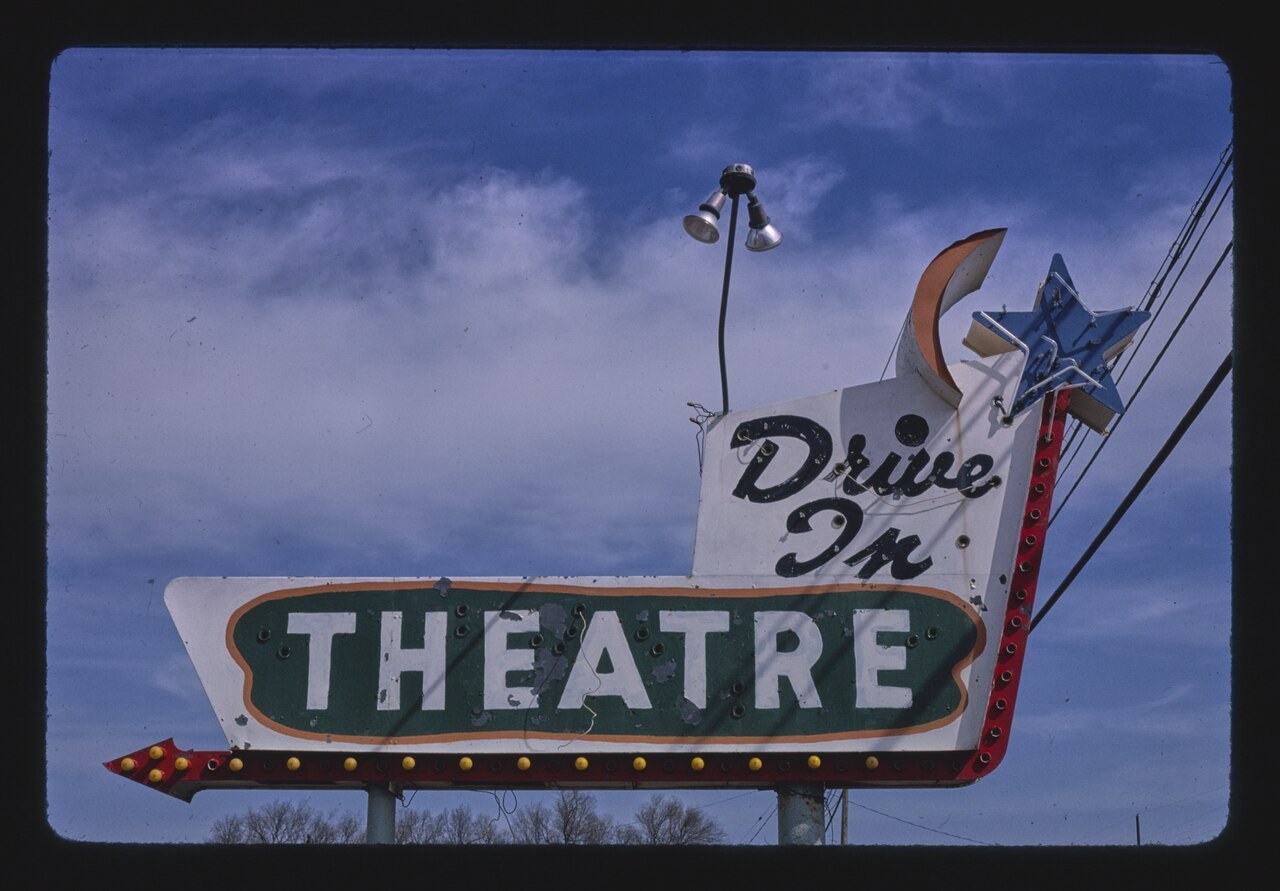
At a drive-in, the room did not go dark because somebody dimmed the lights. The sky had to do its part. That small difference changed the rhythm of moviegoing. There was time to settle in, look around, and watch a familiar outdoor space slowly become a place for a story.
A cinema built around the car
The National Park Service describes the 66 Drive-In in Carthage, Missouri, as part of the drive-in boom associated with postwar automobile travel. Its account highlights the screen, ticket booth, concession building, and parking area. Together, those features made a theater whose arrangement was very different from a row of seats inside a building.
Finding a place to park became part of choosing where to sit. The angle toward the screen mattered. So did who was beside you and what you had brought along. Each car contained a small group with its own conversation, yet everyone faced the same giant picture. The audience was together and separated at once.
The outing around the main attraction
A visit to the concession stand could feel like a journey through the evening. You stepped away from the little world of your car into the larger gathering, then returned with something to share. Remembering the path back can be as vivid as remembering the opening scene of the film.
For families, the drive-in also offered a distinctive way to spend time together. There might be a blanket to arrange, a discussion about snacks, or a child who became sleepy before the story ended. Those details were not interruptions to the memory. Often they are the memory, long after the title of the movie has faded.
A screen with a sky around it
An indoor theater asks you to forget the world outside. A drive-in leaves some of it visible. The air changes as the evening progresses. The outline of the screen remains part of the landscape. A breeze, distant lights, or the shape of the horizon can make a particular visit feel attached to one specific place.
Not every recollection is comfortable. Weather, visibility, and sound could complicate an evening. Remembering the pleasure does not require erasing those inconveniences. They explain why the experience had its own character. It was a movie viewed under conditions that the building, the audience, and the weather shared responsibility for creating.
Drive-ins still give people opportunities to make new memories, so this need not be a story about something entirely gone. What lasts is the combination: a familiar car, a large public screen, and a wait for the light to change. For a little while, an ordinary parking space became a front-row seat to the night. Even the drive home could become part of the evening’s story.
Do you remember the film—or everything that happened before it started?
Sources & further reading
Written with AI assistance. Historical details checked against the linked sources. Our editorial approach
Keep a little yesterday close